Woodlands are a biodiverse habitat that once covered vast areas of southern Wisconsin – and eastern North America. Decades of fire suppression following European settlement have altered these natural communities, and led to species declines. Management using prescribed fire and tree thinning can improve habitat conditions for a wide range of species, but to understand how effective management is for biodiversity conservation, we need to examine the responses of individual species.
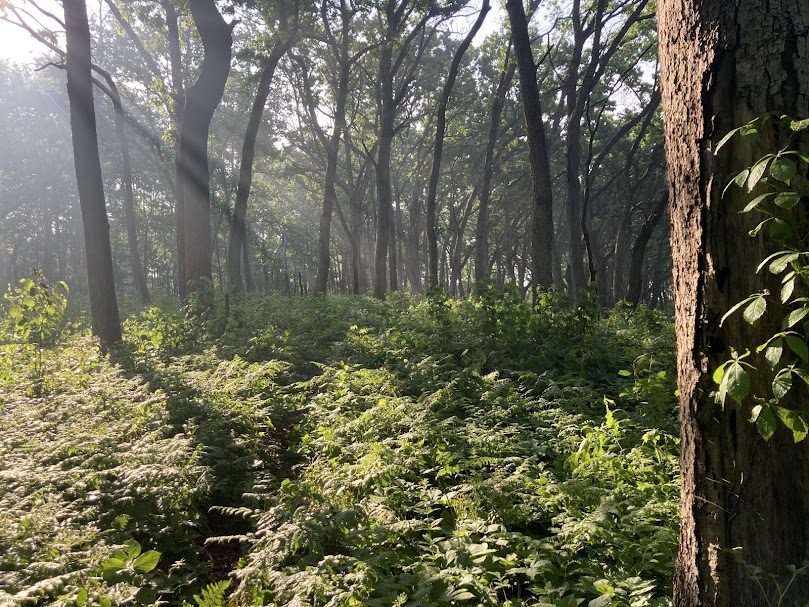

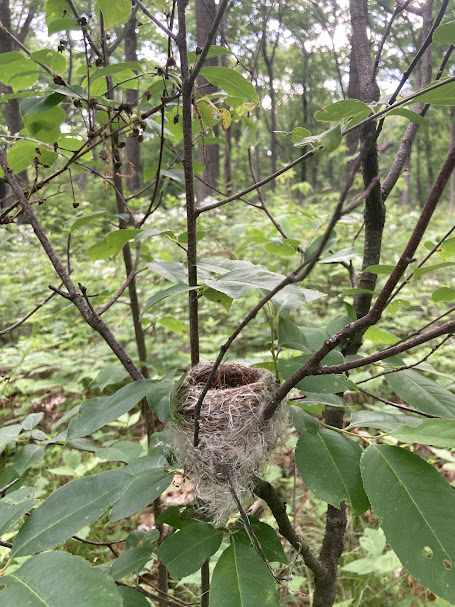
Understanding the landscape context and historical ecology of woodlands can help us consider woodland management within a larger framework. For example, oak woodlands in Wisconsin typically occur on warm, dry sites like blufftops and south- or west-facing slopes. The management work described in this study took place in dry sites where large open-grown white oaks were present – indicating that these areas were former woodlands. Additionally, these sites were all embedded within a contiguous deciduous forest, and populations of interior forest species were present prior to management work beginning. For more information on site histories and management treatment, refer to the research paper linked at the bottom of this page.
Field Study
During 2022 and 2023 we conducted a field study to assess whether management for oak woodland conditions influenced the density of forest birds. We collected data across multiple trophic levels: plants, arthropods, and insectivorous birds. Additionally, we measured the habitat structure and microclimates of our managed and unmanaged woodland sites. Then, we constructed models of bird abundance, allowing us to see whether each species was more or less abundant in managed or unmanaged sites – and what habitat features were driving their distribution patterns. Habitat features included vegetation characteristics (like canopy cover, number of mature oak trees, understory density, etc.), microclimate characteristics (humidity, soil moisture), and arthropod resource availability (aerial insect biomass and foliage arthropod biomass).
We found some key differences between managed and unmanaged sites. First, the understory microclimates differed, with managed sites having higher soil moisture than unmanaged sites, although humidity was similar across sites. Next, we found that managed sites had lower canopy cover, basal area (tree density), and understory density due to thinning of non-oak species. Managed sites also had a higher percent of canopy trees that were oak species. Canopy trees in managed sites tended to be larger (i.e., had larger trunk diameters) than trees in unmanaged sites. Herbaceous plant groundcover, and down woody debris (fallen logs and branches) were more abundant in managed sites, while snags (standing dead trees) were evenly distributed.
These vegetation differences are typical of managed woodlands and unmanaged sites throughout the Midwestern US. And of course, the insectivorous bird community responded to woodland management in a variety of ways, often based on the habitat associations of each species.
Here, we show results for the 21 most abundant species in our study area, organized by foraging guild: foliage gleaners, aerial insectivores, ground foragers, and wood-drillers.
Foliage Gleaners
American Redstart, Blue-gray Gnatcatcher, Cerulean Warbler, Hooded Warbler, House Wren, Indigo Bunting, Mourning Warbler, Red-eyed Vireo, Rose-breasted Grosbeak, Scarlet Tanager, Yellow-billed Cuckoo, Yellow-throated Vireo

American Redstarts are a Neotropical migrant forest generalist that nests throughout eastern North America. In our study area, redstart density was higher in managed sites than in unmanaged sites. Density was positively influenced by arthropod prey – both aerial insect biomass (flies, bees, moths, etc.) and foliage arthropod biomass (caterpillars, spiders, leafhoppers, etc.). Additionally, redstart density was negatively related to canopy cover. American Restart populations are increasing in Wisconsin and much of the central part of their breeding range.
Blue-gray Gnatcatchers have a strong association with oak trees – particularly white oak, which they use for foraging and nesting habitat. Unsurprisingly, these Neotropical migrants were more abundant in managed sites and their density was positively related to the percentage of canopy trees that were oaks. Blue-gray Gnatcatchers build cup nests using lichen and fine plant material held together with spiderwebs. Their populations are declining in Wisconsin and much of the northern part of their breeding range.


Cerulean Warblers are a species of conservation concern throughout the eastern US. The center of their range is in the Appalachian Mountains, and their specific nesting habitat is uneven deciduous forest canopies – particularly large tree crowns on hillsides or places with small canopy gaps in otherwise contiguous forest. Cerulean Warblers migrate to South America each winter, and have been declining for decades. In the Baraboo Hills, they were more abundant in managed sites, and were associated with lower canopy cover and larger mature trees.
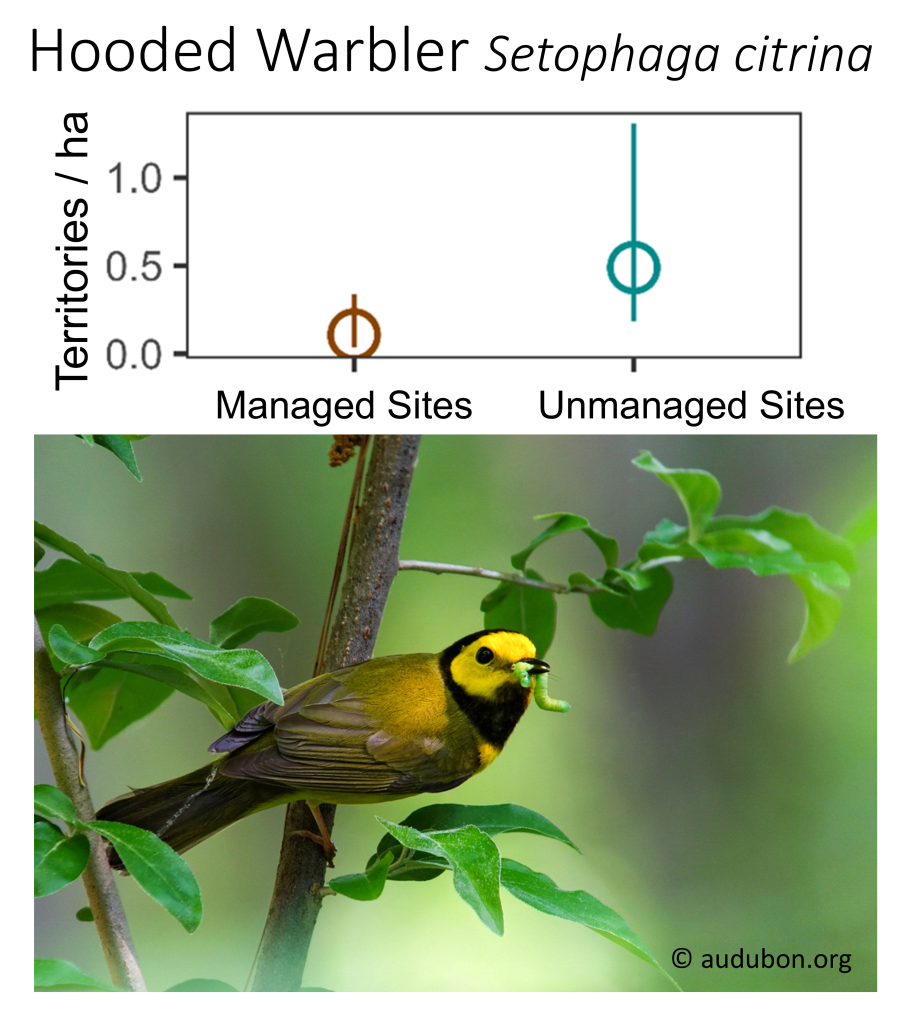
Hooded Warblers are another forest-dependent Neotropical migrant species. They nest in patches of dense understory vegetation within mesic interior forests. We found that Hooded Warblers were less abundant in managed sites. They were positively associated with understory density and negatively associated with the percent of canopy trees that were oaks. However, after shrubs began regenerating in managed sites during the years following a prescribed burn, we observed Hooded Warblers nesting on the edges of management units. Hooded Warblers are declining in Wisconsin and much of the northern part of their breeding range.
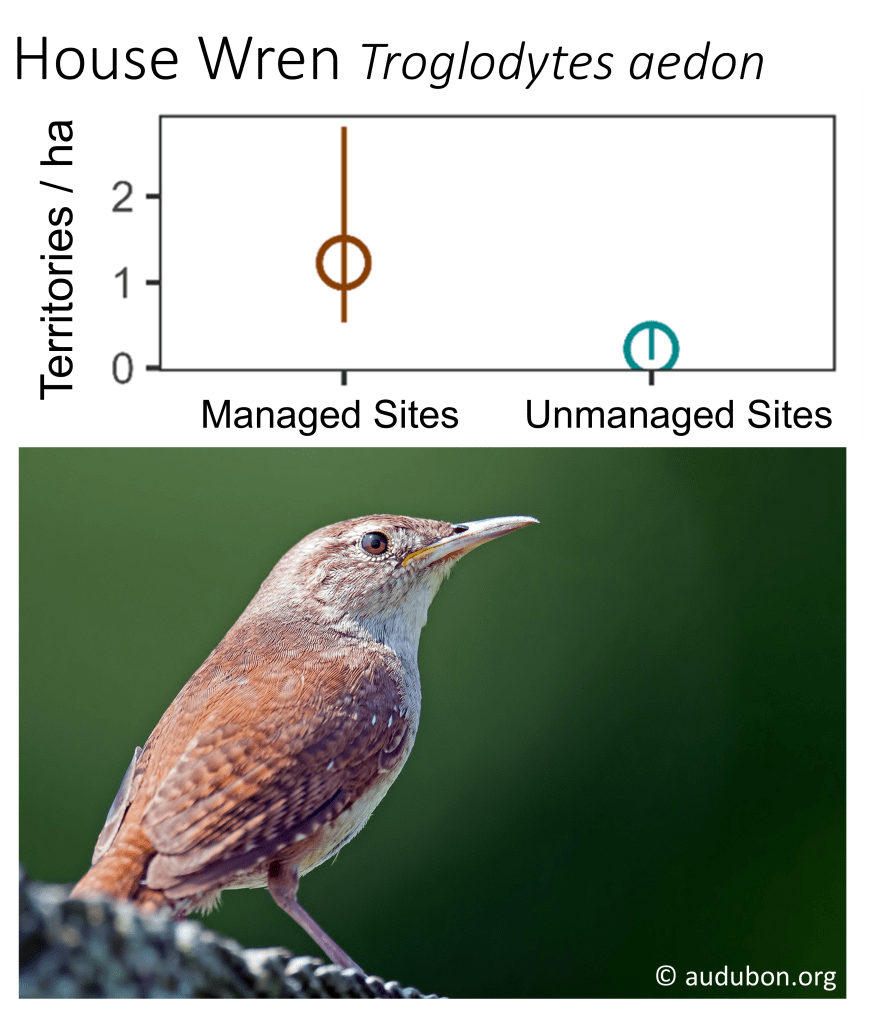
Northern House Wrens are common in many woodland and backyards in Wisconsin. They are often found in dense vegetation and tangles of down woody debris – things like messy wood piles or the crowns of fallen trees, which can persist in managed sites following tree thinning. They also tend to nest in forest edges or shrubby openings. Unsurprisingly, we found that they were more common in managed sites in our study are. They were negatively associated with canopy cover and understory density (i.e., taller saplings), preferring instead the dense ground layer of herbaceous plants, fallen tree branches, and regenerating shrubs in managed sites. House Wrens are facing widespread declines.
Indigo Buntings are found along forest edges, where they can be seen singing from tall exposed perches. However, they nest and forage for insects and seeds in shrubby low vegetation. We found that Indigo Bunting abundance was higher in managed sites, and that abundance was positively related to herbaceous plant cover. In particular, we observed Indigo Buntings foraging in tall patches of herbaceous plants, rubus species (i.e., blackberries and raspberries) and low regenerating shrubs. Like many early-succession species, Indigo Buntings are declining throughout much of their breeding range.


Mourning Warblers are Neotropical migrants that nest in canopy openings with dense shrubs and tall herbs within extensive forests. Like with Northern House Wren, we found that they were negatively associated with understory density (i.e., taller saplings), and instead were common in places with dense regenerating shrubs. They were more common in managed sites, and their distinctive song became characteristic of these woodlands. Mourning Warblers are declining throughout Wisconsin and much of their southern breeding range.
Red-eyed Vireos are common Neotropical migrants species nesting within large forests. They do not have strong associations with particular vegetation conditions, and can be heard singing late into the summer in many Wisconsin forests and woodlands. We found that Red-eyed Vireos were equally common between managed and unmanaged sites and their density was not influenced by any of the vegetation, microclimate, or arthropod variables we measured. Their populations are increasing throughout much of their breeding range.

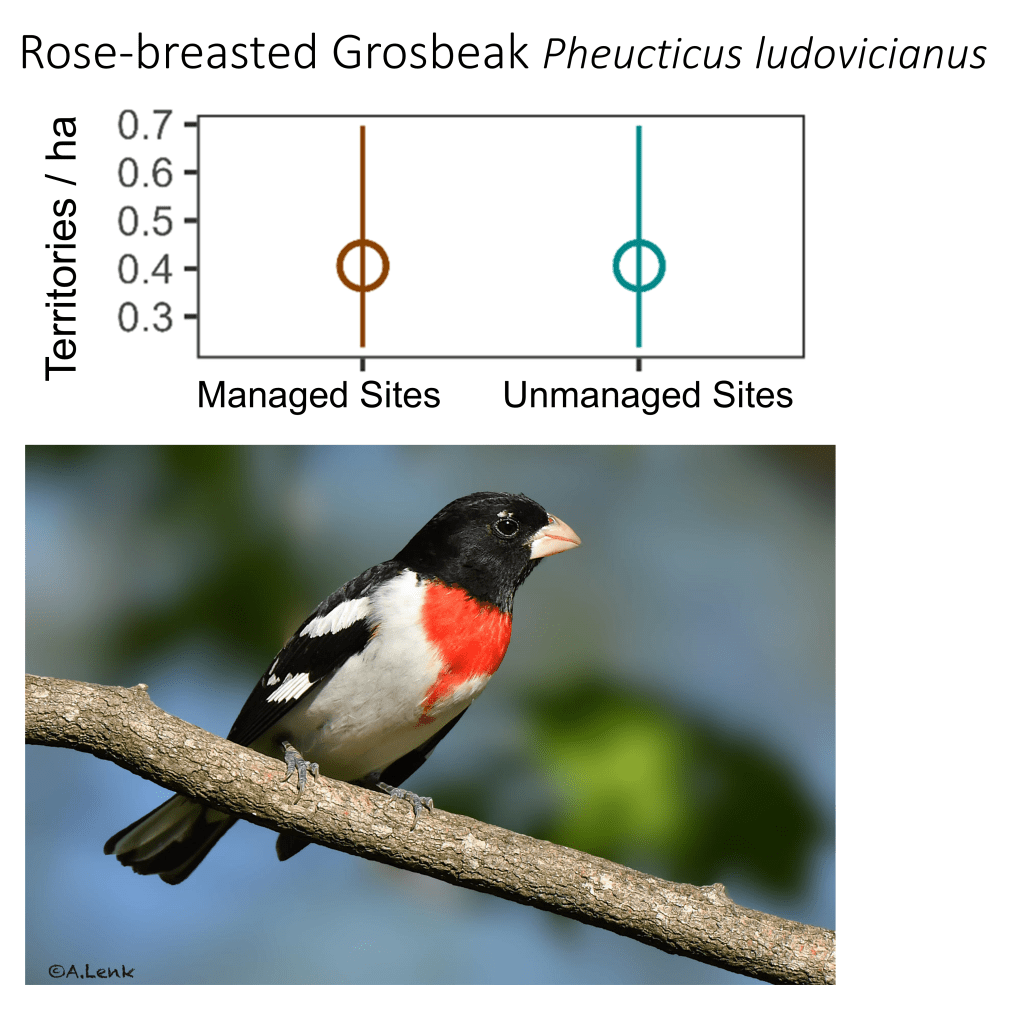
Rose-breasted Grosbeaks are Neotropical migrants that nest in a variety of forest, woodland, and edge habitat in their breeding range. They do not have strong habitat associations, and we found that they were evenly distributed between managed and unmanaged sites. We did find a slight positive relationship between Rose-breasted Grosbeak density and open canopy and understory conditions in managed sites, however, this was nonsignificant. Rose-breasted Grosbeak populations are increasing in Wisconsin and throughout much of their southern breeding range.
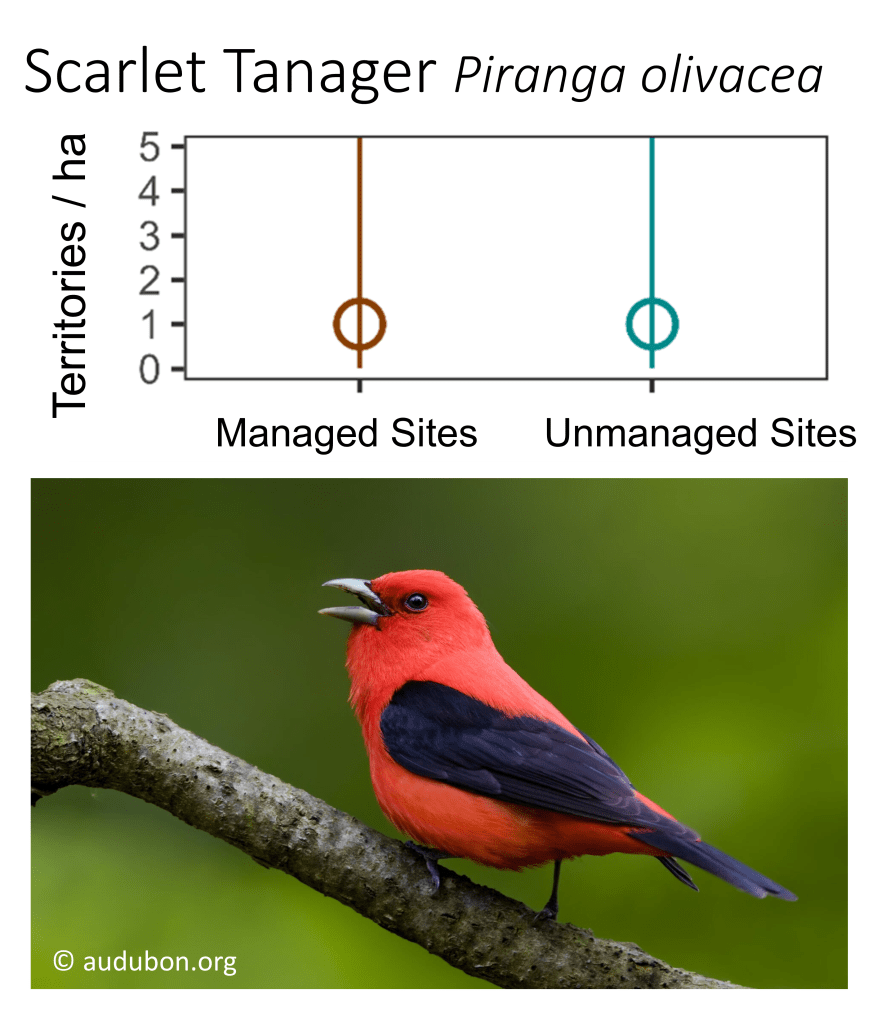
Scarlet Tanagers, another Neotropical migrant species, are dependent on large tracts of forest and tend to avoid edge habitat. However, within interior forests, they don’t have strong associations with vegetation type. We found that Scarlet Tanagers were evenly distributed between managed and unmanaged sites, and that their density was not influenced by the habitat variables we measured in this study. Scarlet Tanager populations are declining throughout much of Wisconsin and their breeding range.
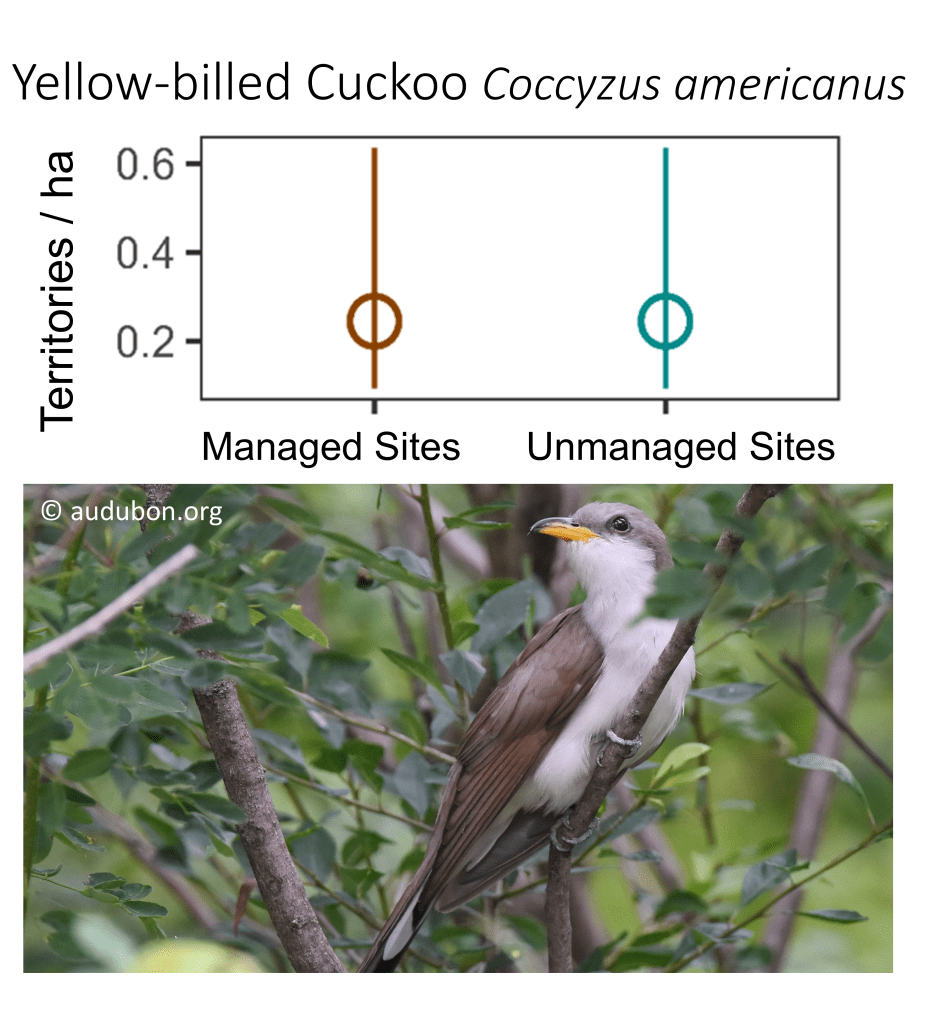
Yellow-billed Cuckoos are a Neotropical migrant species that can travel widely throughout the summer range following cyclic outbreaks of caterpillars. They are one of the few bird species that can eat Eastern Tent Caterpillars, which grow quite large and are covered in hairs. We found that Yellow-billed Cuckoos were evenly distributed between managed and unmanaged sites and that their density was not strongly influenced by any of the vegetation, microclimate, or arthropod variables we examined. Yellow-billed Cuckoos populations are increasing throughout Wisconsin and much of their eastern breeding range.
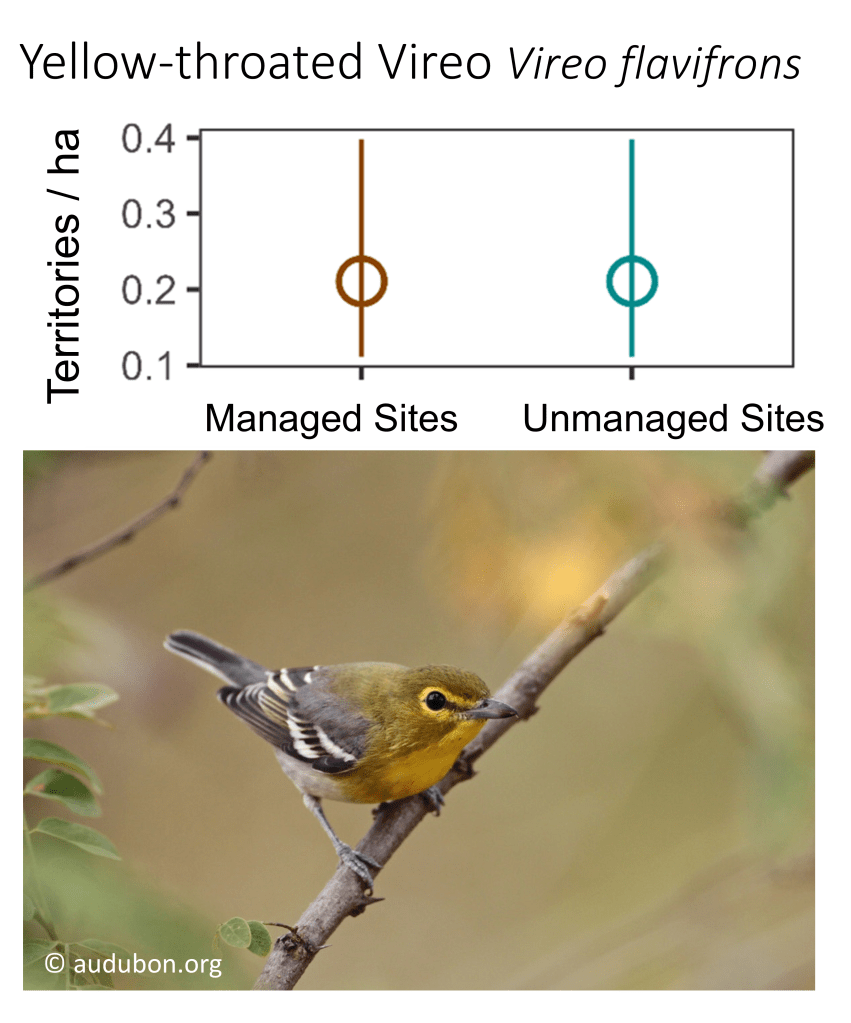
Yellow-throated Vireos are sporadically observed in
deciduous forest canopies near openings and forest edges. We found that they were evenly distributed between managed and unmanaged sites, and that their density was slightly (though nonsignificantly) higher in areas with larger canopy trees but lower canopy cover. In our study area, these stand of large open-grown trees typically occur in managed woodlands or along hillsides in forested stream gorges. Yellow-throated Vireos are declining throughout the Driftless Area in southwestern Wisconsin, but are stable or increasing throughout the rest of their range.
Aerial Insectivores
Acadian Flycatcher, Eastern Wood-Pewee, Great Crested Flycatcher

Acadian Flycatchers are interior forest specialists that reach the northern boundary of their breeding range in the Baraboo Hills. They are a Neotropical migrant species, and nest in the understory layer of stream gorges and mesic forests. Unsurprisingly, given their specific habitat requirements, we found that they were more abundant in unmanaged sites. They are negatively associated with the percent of oak trees in the canopy, and positively associated with humidity, which we found was higher in unmanaged sites. Acadian Flycatcher populations are stable in Wisconsin and increasing through parts of the central breeding range.
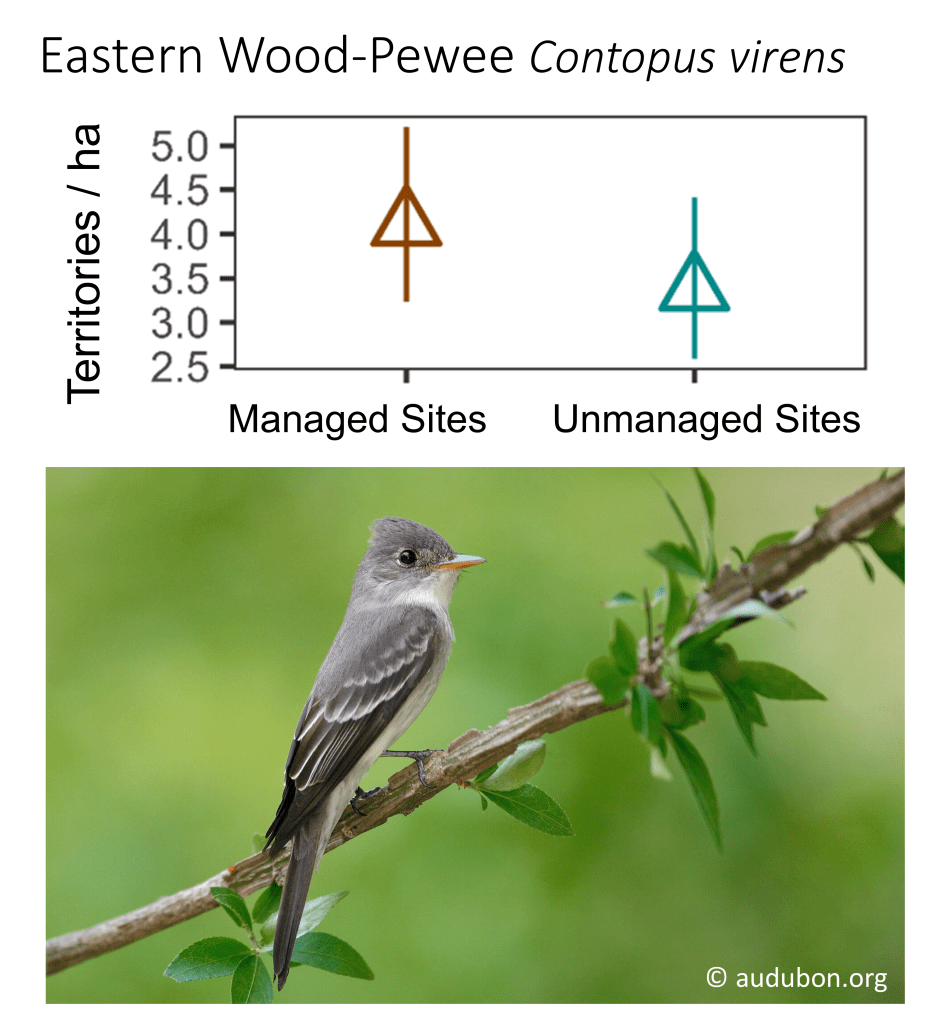
Eastern Wood-Pewees are associated with oak forests
with open lower canopies that afford perches for foraging. We found that Eastern Wood-Pewees were more abundant in managed sites, and were positively associated with open understory conditions, aerial insect biomass, and lower tree density, and oak trees. Eastern Wood-Pewee populations are increasing throughout most of their breeding range.

Great Crested Flycatchers are associated with open and
uneven canopies, which can result from steep slopes, treefall gaps, or woodland management. In our study area, Great Crested Flycatchers were more abundant in managed sites and were positively associated with canopy oak trees. Populations of Great Crested Flycatchers are increasing in Wisconsin and much of their breeding range.
Ground Foragers
American Robin, Eastern Towhee, Ovenbird, Veery, Wood Thrush

American Robins are common throughout many types of forest and (sub)urban habitat. They do not typically have strong habitat associations within Baraboo Hills forests. However, we found higher density of American Robin territories in managed sites than in unmanaged sites. Density was positively associated with tree size, and negatively associated with canopy cover. American Robin populations are declining throughout much of their range.
Eastern Towhees are found in shrubby forest openings and edges. We found that they were more abundant in managed sites and were negatively associated with understory density. Like Indigo Buntings and Northern House Wrens, Eastern Towhees are often found in the dense regenerating lower understory layer that forms in the years following prescribed fires or thinning of the upper understory. populations are stable in Wisconsin but declining through much of the central and southern portions of their breeding range.

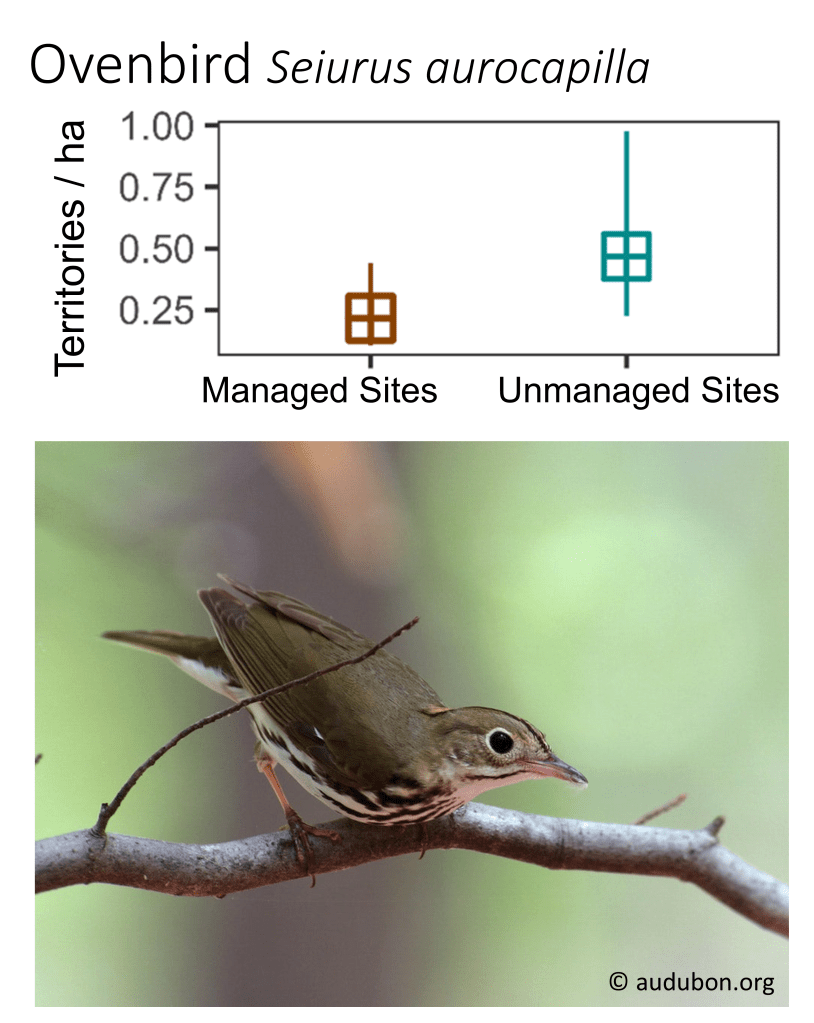
Ovenbirds are associated with stands of small to medium straight-trunked trees – habitat which is typical of unmanaged mesic forests. They nest in the leaf litter on the ground which is reduced after prescribed fires. Thus, we found that Ovenbirds were more common in unmanaged sites. Their density was positively related to canopy cover and negatively related to herbaceous plant cover on the forest floor. Ovenbird population trends are complex – they are decreasing in Wisconsin and other areas in the southern section of their range, and are increasing in the north.
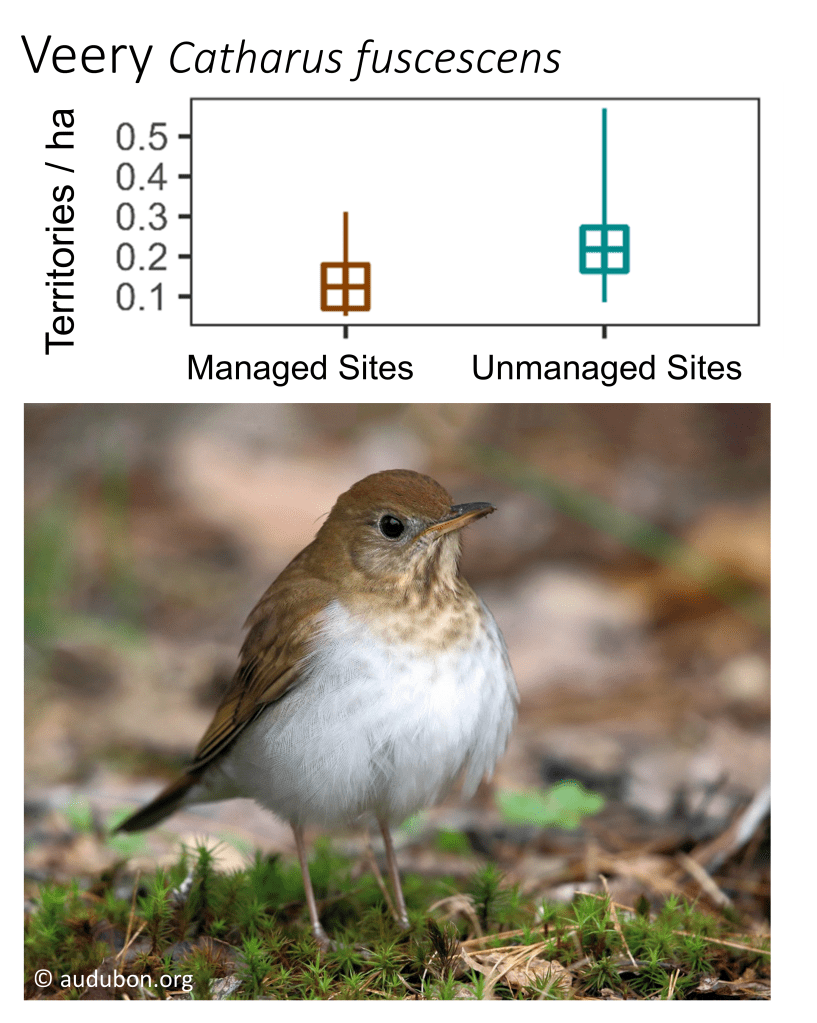
Veeries are associated with mesic
forests and damp sites, and, in the Baraboo Hills, are often found in forested stream valleys. We found that Veeries were positively related to understory humidity and were more abundant in managed sites. Veery populations are decreasing in the Driftless Region of southern Wisconsin, and along the southern edge of their breeding range, but increasing or stable in the north.
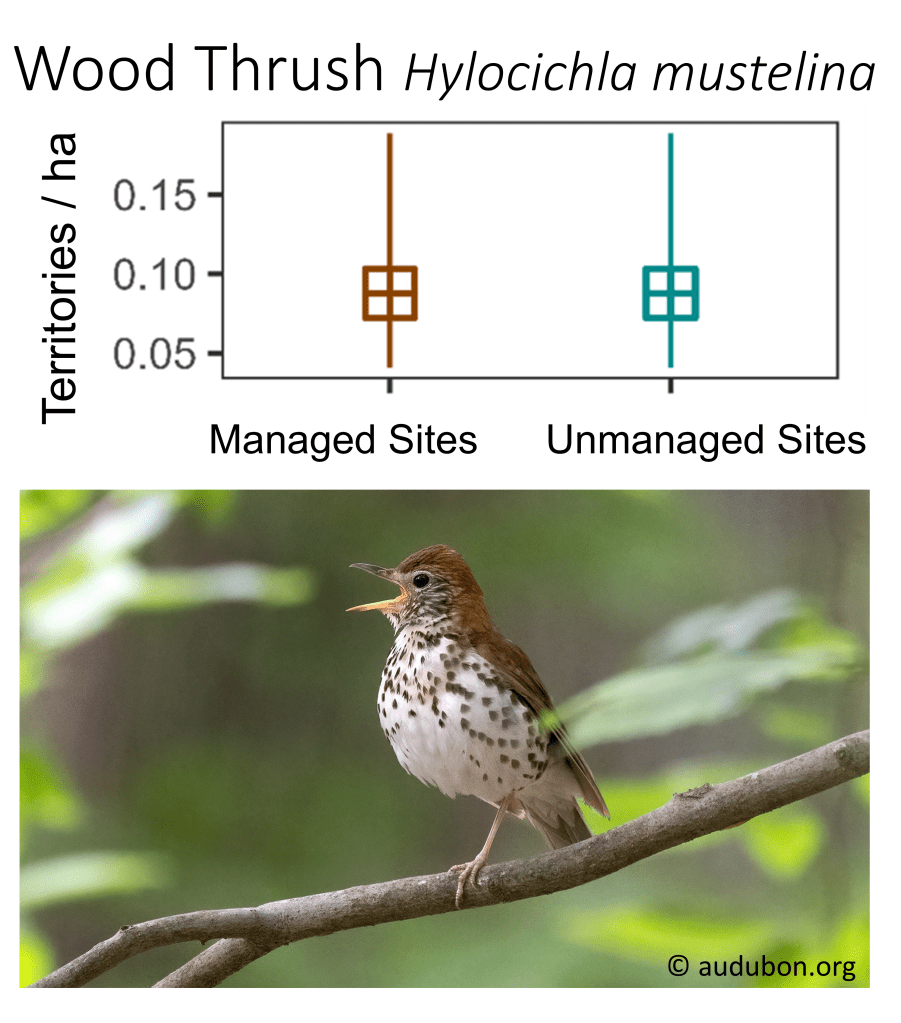
Wood Thrushes are Neotropical migrant interior forest specialists. In their breeding range, they are found in forests with high canopy
cover, but also frequently nest among dense saplings resulting from treefall gaps. Thus, Wood Thrush benefit from patchy disturbance within interior forests. We found that Wood Thrush density was evenly distributed between managed and unmanaged sites, and that density had a weak negative relationship with oak trees. We observed Wood Thrushes foraging and nesting in managed sites more often after the understory vegetation had regenerated following fires. Wood Thrush populations are stable or increasing throughout Wisconsin and much of the central breeding range.
Wood-drillers

Red-bellied Woodpeckers occur mostly in forested habitats with semi-open canopy and high importance of oaks. We found that they were evenly distributed between managed and unmanaged sites. Their density was not strongly re,ated to any of the habitat variables that we measured in this study. Red-bellied Woodpecker populations are increasing throughout Wisconsin and nearly their entire range.
This research was done as part of of Maia’s PhD at the University of Wisconsin-Madison, with her advisor, Dr. Anna Pidgeon , and retired DNR forest ecologist Mike Mossman. A PDF is available here:
Click here to make a donation!
 Baraboo Hills Ecology Research Collective